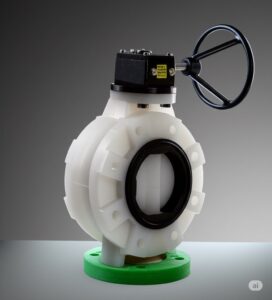
TL;DR: A PVDF butterfly valve is a compact, quarter-turn valve often used in corrosive or high-purity service where you want low pressure drop and simple actuation. Specify it correctly by confirming (1) the seat and elastomers match your chemical at temperature, (2) your line pressure/temperature are within de-rated limits, and (3) actuator torque is sized for the worst-case condition (cold start, max ΔP, frequent cycling).
Search results for PVDF butterfly valve often focus on general butterfly valve selection, but the most common real-world failures in chemical service come from mismatched materials (seat/liners/elastomers) and undersized actuation. This guide is a “spec-first” overview so you can pick the correct design the first time.
Why choose a PVDF butterfly valve?
- Compact and lightweight for larger sizes where ball valves get heavy and expensive.
- Low pressure drop in fully open position compared with many control-style valves.
- Lower stem torques can make automation more economical in many plastic valve designs.
What “PVDF butterfly valve” can mean (and why it matters)
Suppliers may use “PVDF butterfly valve” to describe different constructions:
- PVDF body (thermoplastic body) with an elastomer seat.
- PVDF disc in a body made from PP/PVC/CPVC/PVDF (common in corrosive services).
- Fluoropolymer-lined butterfly valves (often PFA-lined metal/composite bodies) for higher temperature or severe chemicals.
Across suppliers you’ll see PVDF disc options called out specifically, and many ranges emphasize relatively low stem torque (which can reduce actuation cost) in plastic butterfly valve designs.
Selection checklist (use this before you request a quote)
1) Media details (the “chemical spec”)
- Chemical name(s), concentration, temperature range (including cleaning cycles)
- Any solids, crystallisation risk, viscosity changes
- Is the service continuous throttling or mostly on/off?
2) Pressure/temperature reality check
Plastic valves are de-rated with temperature. Don’t size from room-temperature catalog ratings. Confirm your maximum operating temperature and surge pressure.
3) Seat and seal materials
The seat and O-rings often determine chemical compatibility more than the body does. Choose the seat/elastomer based on your exact chemical and temperature (EPDM, FKM, FFKM, PTFE-backed diaphragms, etc.). If you are unsure, start here:
4) Body style and installation constraints
- Wafer vs lug: wafer is compact; lug can allow dead-end service depending on design.
- Flange compatibility: verify bolt pattern and any gasket requirements.
- Service access: confirm you can remove/inspect without dismantling large pipe sections.
5) Actuation torque (don’t guess)
Torque requirements change with pressure differential, seat type, temperature, and cycling frequency. Oversights here show up as stalled actuators, broken gear operators, or leaking seats. Ask for a torque curve or minimum actuator torque recommendation at your conditions.
Sizing basics: flow, Cv, and why butterfly valves often look “too good” on paper
Butterfly valves can pass high flow in a compact envelope, but throttling near closed positions can increase velocity, noise, and wear. If you need precise control (not just isolation), consider whether a control valve or a segmented/V-port design is a better fit.
Common PVDF butterfly valve mis-specs (and how to avoid them)
- Assuming “PVDF” covers all wetted parts: specify disc, seat, shaft isolation, and elastomers explicitly.
- Ignoring temperature spikes: include cleaning cycles and ambient extremes.
- Undersizing actuators: size for worst-case torque, not average torque.
- Using butterfly valves where bubble-tight shutoff is critical: confirm leakage class expectations with the supplier.
Related engineering resources
- PVDF Valve End Connections
- What Is a PVDF Ball Valve? Materials, Design, and Benefits Explained
- Discuss your application and request a 48-hour RFQ
Frequently Asked Questions
They can throttle in many services, but if you need precise control over a wide range or you have high ΔP, slurry, or flashing risk, a dedicated control valve design may be a better fit. Specify the duty cycle and control intent when quoting.
In chemical service, the seat and elastomers often determine reliability. Always specify the seat and O-ring materials and confirm compatibility at operating temperature.
Ask for published torque requirements at your pressure and temperature and size the actuator for worst-case conditions (cold start, max ΔP, frequent cycling). Avoid sizing from generic “rule of thumb” values.