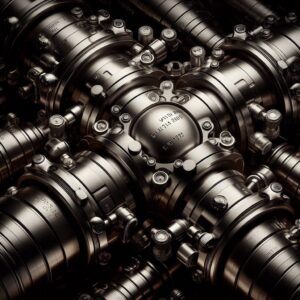
TL;DR: PVDF valves handle corrosive and high-purity fluids; this hub compares valve types, wetted materials, and selection steps so you can specify correctly and avoid common failures.
If you are selecting PVDF valves for chemical handling, semiconductor utilities, pharma/biotech, or corrosive dosing systems, you are usually balancing three things at once: chemical compatibility, pressure/temperature limits, and reliability over a long service life. PVDF (polyvinylidene fluoride) is often chosen because it handles harsh media better than many plastics, while staying cleaner and lighter than many metals.
As a leading PVDF valve manufacturer, we focus on delivering high-purity, zero-corrosion solutions for the most demanding industrial environments.
This page is the hub for our PVDF valve knowledge base. It links to detailed guides for specific valve families and applications.
What is PVDF, and why is it used for valves?
PVDF is a high-performance fluoropolymer. In valve bodies, it is valued for:
- Broad chemical resistance in many aggressive liquid services.
- High temperature capability for a thermoplastic (often specified up to around 120–140°C, depending on design and pressure rating).
- Low contamination risk compared with metals and many filled plastics, which matters in high-purity systems.
- Mechanical strength that supports robust union, flange, and actuation-ready constructions.
In practice, PVDF valves are often chosen where corrosion, scaling, or product purity issues make metal valves or metal-lined valves risky. For a deeper look at durability, see our guide on Leak-Proof PVDF Valves and Lifespan.
PVDF valve types (quick selection guide)
Choosing the right valve starts with the job it needs to do: isolate flow, prevent backflow, regulate flow, protect against over-pressure, or dose chemicals precisely.
PVDF ball valves (on/off isolation)
Ball valves are common for fast quarter-turn shutoff and low pressure drop.
- Best for: isolation, diverting flow (with multiport designs), frequent operation.
- Watch-outs: throttling a standard ball valve can erode seats and reduce control accuracy.
Learn more:
- What is a PVDF ball valve?
- PVDF vs PVC/CPVC ball valves
- PVDF 3-way ball valves (L-port vs T-port)
PVDF diaphragm valves (clean shutoff and throttling)
Diaphragm valves isolate the actuator/bonnet from the media using a diaphragm, which is often attractive for corrosive or contamination-sensitive lines.
- Best for: slurries, corrosive services, frequent cycling, applications needing clean containment.
- Watch-outs: diaphragm material selection is critical; temperature and chemical limits vary by diaphragm type.
Learn more:
PVDF butterfly valves (compact isolation for larger lines)
Butterfly valves are compact and economical for larger diameters, with good shutoff when correctly specified.
- Best for: larger bore isolation, utility service, moderate throttling (design-dependent).
- Watch-outs: seat/disc compatibility and pressure class; ensure the seat material matches the chemical and temperature.
Learn more:
PVDF check valves (preventing reverse flow)
Check valves protect pumps, prevent backflow, and maintain prime.
- Best for: non-return protection in chemical transfer, dosing, and utility loops.
- Watch-outs: cracking pressure, orientation limits, and solids that may prevent sealing.
Learn more:
- How PVDF check valves work
- PVDF foot valves and anti-siphon valves
PVDF control valves (modulating control)
Control valves regulate flow or pressure in a controlled, repeatable way.
- Best for: process control loops, continuous regulation, automation.
- Watch-outs: required rangeability, Cv sizing, actuator selection, and compatibility of trim/seals.
Learn more:
Pressure and flow control: regulators, relief valves, and needle valves
These valves solve problems that isolation valves cannot:
- Pressure regulators: maintain a target downstream pressure (pressure reducing) or upstream pressure (back pressure).
- Pressure relief / safety valves: protect equipment by opening at a set pressure and diverting flow.
- Needle valves / metering valves: provide fine, stable flow adjustment for dosing, sampling, and calibration lines.
Solenoid and dosing valves: solenoids, injection valves, and quills
For many chemical dosing and high-purity utility tasks, fast, repeatable on/off control is needed.
- Solenoid valves: electrically actuated on/off control, often in chemical distribution or equipment skids.
- Injection valves and injection quills: introduce chemicals into a process line safely while preventing backflow.
Material options you will see in PVDF valves
Most PVDF valves are not a single-material product. Even when the body is PVDF, the sealing system is usually a mix of fluoropolymers and elastomers.
Body materials
- PVDF (solid-body): general-purpose chemical resistance and good temperature performance.
- UHP / high-purity PVDF: specified for contamination-sensitive lines, especially semiconductor UPW and high-purity chemical distribution.
- PVDF variants (e.g., Kynar® PVDF): often used as a resin family reference in specifications.
Seat and diaphragm materials
- PTFE / modified PTFE (TFM): common for seats and diaphragms where chemical resistance and low friction are needed.
- EPDM / FKM / FFKM: elastomers used for O-rings and sealing; selection depends strongly on media and temperature.
- PTFE-encapsulated elastomers: sometimes chosen to combine chemical resistance with elasticity.
A practical way to avoid early failures is to treat seal selection as a separate engineering decision, not a default.
How to specify a PVDF valve (step-by-step)
If you want repeatable performance, specify the system conditions first, then the valve, not the other way round.
Step 1: Define media and concentration (and what can change)
Write down:
- Process media (including cleaning chemicals and start-up/shutdown chemicals).
- Concentration range and impurities.
- Whether the fluid is oxidising, contains halogens, or carries solids.
If the media can change (for example, alternating acids and rinse water), specify for the worst-case chemical exposure.
Step 2: Define temperature and pressure across the whole duty cycle
PVDF valves have pressure/temperature ratings. A valve that is safe at ambient may not be safe at elevated temperature. Specify:
- Operating temperature range (including cleaning cycles).
- Normal operating pressure and maximum pressure.
- Transient conditions: pump deadhead, water hammer, pressure spikes.
Step 3: Choose the valve function and control method
- On/off isolation: ball or butterfly valves are common.
- Throttling or clean shutoff: diaphragm valves or purpose-built control valves.
- Backflow prevention: check valves, foot valves, anti-siphon valves.
- Pressure management: regulators and relief valves.
- Automation: pneumatic or electric actuators, position feedback, and fail-safe requirements.
Step 4: Select end connections and maintenance strategy
True-union ends are often chosen to simplify service and replacement. For larger lines, flanged ends may be preferred.
Consider:
- Union vs flanged vs threaded.
- Whether you need to remove the valve without cutting pipe.
- Whether spare seal kits will be held on site.
Step 5: Specify seals, seats, and any wetted metals
Many failures blamed on “PVDF” are actually seal failures.
- Confirm O-ring/diaphragm compatibility with the chemical and temperature.
- For dosing accessories (injection valves/quills), confirm any spring material in contact with media if applicable.
- For high-purity service, confirm extraction/contamination requirements and packaging/handling needs.
Common mistakes (and how to avoid them)
Using a ball valve as a control valve
A standard ball valve is built for on/off service. If you need stable regulation, choose a control valve or a needle valve, depending on flow range.
Ignoring cracking pressure and orientation on check valves
Check valves are not interchangeable. A small change in cracking pressure can affect dosing accuracy or pump performance.
Specifying only the body material
“PVDF valve” is incomplete as a specification. Seals, seats, diaphragms, and actuation details often decide reliability.
Skipping high-purity handling requirements
In contamination-sensitive lines, how valves are manufactured, handled, and packaged can matter (clean production, controlled packaging, and leak/pressure testing are common requirements). If you are specifying UHP PVDF for UPW or high-purity chemicals, include your purity/testing expectations explicitly.
Recommended next steps
If you want help selecting the right PVDF valve for your duty, gather your media, concentration, temperature/pressure range, and target connection size. Then start with the valve family above and validate seals and ratings before final specification. For a complete list of technical resources, visit our Valve Knowledge Base.